Storm Clouds and Snake Oil Salespeople: New Advice on AI Integration in the Wine Business.
And then there was the bad weather. So goes the opening line in Hemmingway’s A Moveable Feast, and it’s as great an opening line as I’ve ever read. It says everything without saying a word about the thing, and the phrase speaks to our souls. After all, we humans know from somewhere primal that things are cyclical: something came before that’s outside of us and it will come again. Having that unique understanding as human beings is as good a definition of consciousness as I can offer, especially now that we’re in bad weather with all this AI discourse. The euphoria and nervousness surrounding novelty have given way to deep anxiety and fear. Some of the very humans who have built this technology and unleashed it on society have come out to say it’s going to kill all of us, and very soon. Other humans who have become fabulously rich by enabling AI technology’s proliferation are countering the hype by saying that such doomsday fear is silly. Each side seems all too human and self-motivated. But storm clouds keep rumbling.
Could Artificial Intelligence kill us? Of course: every massive leap in technology that we create could and maybe will kill us. Many ideas that have come from our monkey brains might have destroyed us quickly if we didn’t put systems around them, try to set down our civilizational differences, and at least try to align technology with the most ethical outcome for all of humanity. Nuclear fission and fusion come to mind. But even the very good efforts to reign-in nuclear technology since World War II have not been perfect. In fact, a nuclear war might still kill us before AI robots do. Or: they might do it together. Then again, lots of other technologies we’ve created—from food manufacturing to plastics and antibiotics—could end up wiping us out not with a bang but a whimper.
All of this is to say what I am always saying: while I enjoy the existential discourse as much as the next nerd, let’s remember to get back to work. Heads up people: there is still lots of wine to be sold before we all get turned into paperclips.
When it comes to the interface of AI and the wine industry, I’m learning just as much as the next person. I’ve never been a luddite (those who read my articles know that); but I also am a strong defender of human experience and capability while being a firm advocate of human and computer alignment and symbiosis. Leaving authentic wine production aside (I’ll let those more experienced in viticulture and winemaking chime in there), these are my current observations and advice for the wine business concerning AI integration. I hope it will shed some light in this dark hour:
1. Getting help is OK but write and communicate in your own voice. If you can’t write, then AI will not make you a better writer. Maximized token logic creates what is very predictable now, and most people in our business can quickly sense AI-generated writing. The latest article in Wine Business about the hullabaloo at a wine writer’s conference by Henry Jeffrey’s shows this issue hitting an inflection point. I learned about Pangram from his article, so of course I had to jump on it and run all my articles through it to see what came back. It was cool to observe. I’m glad to see that I’m not living in a simulation and that my body has not been taken over by a robot: everything I have claimed to write myself, Pangram agrees (see screenshot below). The AI “written article” was my last, which of course was largely a debate between Chatbots that I published, so that was almost my control in the Pangram experiment. Pangram got it right that my opening paragraphs and questions were written by a human and that the AI responses were 100% AI. But it also got some parts wrong, especially highlighting as AI-assisted some of the explanations I wrote about my own college honors thesis. I can see tools like this and others proliferating quickly in the business community. Not only are people becoming increasingly suspicious of AI-generated writing in business communication, I assume very soon that Google or someone will buy Pangram and I’ll be alerted up-front whether an email or text I’m receiving is baloney.
I am a proponent of AI assistance in business communication, especially when it speeds up complex communication at the executive level. I received a very well formatted email from the president of an organization I interact with a couple weeks ago, and I immediately recognized it and thanked him for it. I recognized the structure of AI assistance, but I also recognized all the thoughts and analysis as his because the topic we were discussing was complex and took very specific wine industry experience to reason through. The AI assisted structure he used made our “debate” go quickly because we got to the crux of the matter very quickly and we therefore settled the negotiation very quickly.
However, when I received a text from a colleague that was clearly and obviously entirely generated by AI, I called her out. A smart and honest person, this happened to be a colleague in Europe whose first language is not English. As fluent as she is, she felt a bit frustrated trying to explain her side of a negotiation and defaulted to having a chatbot write the text for her. I didn’t appreciate it and just wanted her thoughts no matter the perfection of the writing. We agreed that we would both continue using translation AI when we wrote longer emails to assure neither of us explained something in an awkward way in our non-native tongue, but that for texts we would always use our own voice in either language and let mistakes be a part of the conversation. That would always be our path to clearing up any misunderstanding while we both communicated in a second language.
My advice for wine business owners, operators and executives: let your preferred chatbot(s) learn your preferences and keep updating them to reduce sycophancy and ghostwriting. Feed them prompts such as “Always keep my own voice when I ask for my writing to be reviewed for errors, and act as an editor, not a ghostwriter. I’m looking for flagging grammar errors, calling out redundancies and other plain mistakes. Do not change my writing or ideas.”
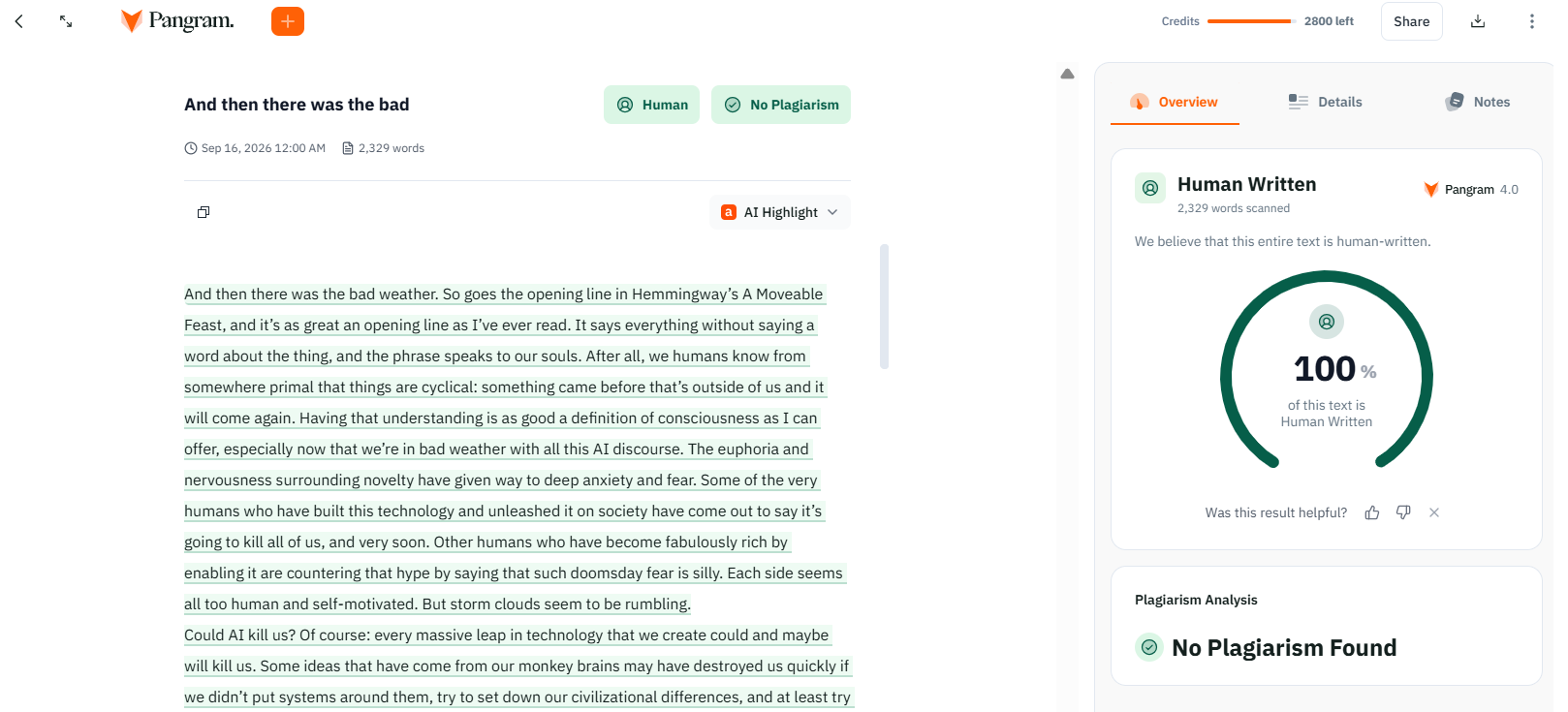
Pangram agrees that I wrote this article. Darn right!
2. Accounting and financial knowledge are critical. Just as AI will not make you a better writer, it will not make you better at math or the math-based fields of business such as accounting and finance. Moreover, you don’t need to be able to do the math (especially on the fly) to prove you understand an analytical or business concept. That’s why math and data insights are two different sections on today’s GMAT. But if you cannot explain an accounting or finance concept given to you by AI without using AI or any other reference tool, then don’t incorporate it into your business communication.
My favorite right now for Excel work is ChatGPT. It might be due to Microsoft being a major investor in OpenAI so integration with Excel is optimal, or it’s just getting better with my work and learning from helping me with streamlining multiple financial and operational models. Either way, I am saving countless hours and actual headcount at this point by using Chat to help me with spreadsheets.
But Chat makes simple, weird mistakes. Some of these are mathematically quite simple and really headscratchers, others come out of the LLM’s apparent attempt to maximize spreadsheet organization and efficiency while producing strange reasoning. That is because it takes both common sense and experience to be an expert in any business field. Chat doesn’t have any experience in the wine business. Don’t forget that.
My advice with spreadsheet help is similar to my advice with AI assisted business communication and writing: review everything, don’t let the LLM change or alter your original idea for the analysis, and have a human check on important results, whether that’s you (if you’re capable), a finance expert, or an accountant.
More importantly, I disagree with those who say knowledge of spreadsheets or even fundamental analytical areas of business operations is becoming a waste of time in an Agentic AI world. I expect current and next-gen AI systems to get faster and better (and quite quickly) in accounting and even financial analysis. But my advice has not changed for those of you in the sales and marketing side of the business who are trying to advance in your career, launch your own business, or learn how to run a family business without any financial background: take some accounting and finance classes, formal or otherwise. When I was making the move from executive sales management to C-suite management, I recognized the missing gap in my own education and drove myself every Monday night from Napa to UC Berkeley to take an advanced accounting and finance course over two semesters. I had to get over the fear of being with real Berkeley finance students and seeming like the uneducated old guy in the room (that didn’t happen; the students loved having my real-world perspective in the class) and I had to invest massive amounts of time for commuting, studying, and acing the class.
Today, such education is way more accessible than it was then. Online courses range from free to premium. There is no excuse for not leveling yourself up in hard skills. To this day, the many experiences I’ve had across multiple tiers of industry are what I think create my expertise, but it was that course at Berkeley that helped me advance from playing guitar by ear to site reading music. Having those hard skills now so that you can steer AI assistance in the next several years and continue to either advance your career or your company is critical, not superannuated.
3. Beware of Snake Oil salespeople. This is, I believe, my most important piece of advice. The term “snake oil salesperson” is now an idiom but was based on a real phenomenon of traveling con-men emerging around the 1880s. The term comes from the fact that they were taking something real—a new type of ointment that had Omega-3 in it derived from newly imported Chinese snake venom—and creating false remedies with bogus ingredients purporting to cure everything that ails a human. The snake oil salesperson phenomena boomed not because of the importation of this rare snake, but, I believe, as an historic phenomenon linked to the advent of the railroad, printing efficiencies for advertising, and the fact that legitimate medicine was advancing at a frighteningly fast pace during the same time. In short, the snake oil salesperson shows up whenever we have these massive shifts or advancements in technology and industry. My gut told me the phenomenon reaches back as far as history can record, and my research has proven this to be true. Snake oil salespeople have been around at least since Babylon.
In fact, one of humanity’s earliest surviving legal codes regulated false practicers of medicine and surgery as far back as 1750 BCE as these ancient snake oil salespeople became quite common during the time when systematized healing had become commercialized. Snake oil con men then appeared again in ancient Greece during the period of the Sophists. This caused the Hippocratic Oath to emerge. They popped up again in Rome where people were literally being sawed and hacked apart in the name of science. All of it was history repeating itself: people purporting to have knowledge during a seismic shift in technology, culture and society, and not being able to deliver on their promises.
Today, I’m seeing snake oil salespeople pop up all over as the alcohol industry goes through some serious structural shifting and the AI revolution emerges. Snake oil salespeople need a cohesive target: a customer and a community filled with fear and the desire for a panacea. To be fair, not every snake oil salesperson is unethical. Some are just scared because they recently lost a job or are trying to adapt to a world that scares them. Dark clouds emerge, the media starts talking about the end of the alcohol industry and even the world, and snake oil salespeople strike.
One such person reached out to me recently. I didn’t know his name, and he seemed to have an adjacent but not specific wine industry resume when I looked him up on LinkedIn. He was a real person; I could verify that. He emailed me that he was working on a powerful new AI-driven tool for the wine industry that would be a critical analytical advancement for wineries and distributors. I asked him to read my recent article and give me both his thoughts on the simulated AI debate and, more importantly, his thoughts on my theories about AI given my academic and professional background. He never replied. That was the non-answer I needed to know that he was peddling lies.
To call out a snake oil salesperson you must sharpen your hard skills so that you can recognize them. Even if you’re convinced that their oil might be useful, really mastering the hard skills in the business will help you measure the oil’s effectiveness and value. As social and traditional media go wild right now with debates about the end of the world and people scramble to pretend that they are experts in a technology they don’t understand, my strongest advice is to sharpen your industry hard skills and remember that—even in a world of AI and GLP1s—there a never, ever any shortcuts.
PS: I did it. I used em-dashes throughout this article. I once used them all the time and loved them as a writing tool, and then chatbots ruined it all. But no more. I know how to use an em-dash, and I’ll use one as I please, thank you very much.
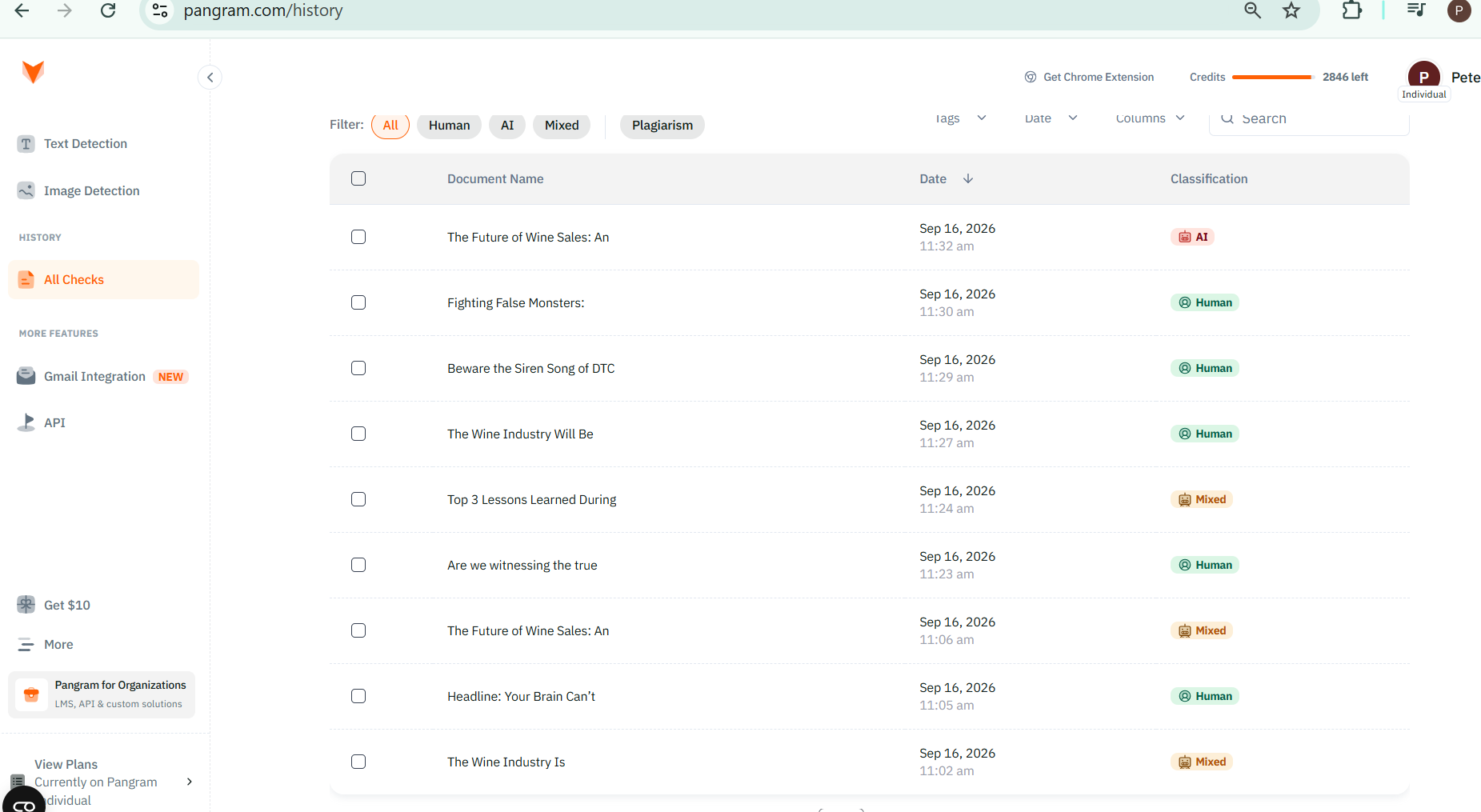
Good results on my Pangram test of all my articles so far. The Future of Wine Sales was the publication of a debate I created between chatbots, so obviously AI.