The Future of Wine Sales: An AI Roundtable with ChatGPT, Claude, and Gemini
Thirty years ago, as an undergraduate at Tulane University, I wrote my honors thesis on the changing structure of logic in Western language, which earned me the Glendy Burke Award for Academic Excellence. I had no idea what large language models were, or that they would exist within my lifetime. In fact, I suspected that the next great shift in human-computer cognitive coordination would emerge through virtual reality. As it turns out, I was like Mark Zuckerberg, wearing rose-colored VR glasses. I predicted in that paper that VR would be the first technology that proved my thesis.
Even though I got the medium wrong, I think my work gave me an unusual lens through which to view today’s AI revolution. My thesis explored the idea that meaning does not necessarily emerge from a single, centralized source, or Logos, but from relationships within language itself. At the time, it was an abstract philosophical argument. Today, watching modern large language models operate, I cannot help but see that idea in action.
I use AI every day. Chat is my primary assistant for spreadsheet help, coding help, and general research, but I regularly compare its responses with those of Gemini and Claude. What I don’t ever do is ask any AI to write for me. The theories, arguments and conclusions I publish are my own. I sometimes use these tools to identify grammatical errors, or to test structure, but I do not publish AI-generated prose or pass its ideas off as mine.
What fascinates me is not simply that these models can write. In fact, I'm not impressed with their writing, which I find predictable and formulaic. What interests me is how they arrive at what they write. It goes back to my thesis about Logos and admittedly captivates me.
According to my current understanding, an LLM does not consult a hidden database of opinions, nor does it possess a centralized belief system or demonstrated consciousness (I like to remind my friends who warn of AI consciousness that humans don’t even fully understand what consciousness is or how it emerges in humans, so let’s not start assigning it to algorithms). Moreover, AI contains no master definition of objects or ideas like “wine,” “trust,” or “sales.” My college thesis advisor, who was supportive even as he disagreed with my thesis, would cringe at hearing this: AI does not contain any Platonic Forms. Instead, it generates language from statistical relationships learned across enormous quantities of human writing and recorded speech. Though he drives all pragmatists up a wall, Jacques Derrida was likely correct when it comes to the deferred logic that is an LLM.
At each step, an LLM assigns probabilities to tokens (the smallest unit of text it can process) that might possibly come next, given the prompt, its instructions, and everything already written in the conversation. It does not necessarily select the single most likely token, and a token is not always a complete word. The best way it's been described to me by my computer science friends is that a token is like a Scrabble tile. Just as you can build an almost unlimited number of words from a relatively small set of tiles, an LLM builds language from a relatively small vocabulary of reusable pieces rather than memorizing every possible word or sentence in the universe of language and spitting it back out in predictable patterns. That local, token-by-token process compounds into sentences, paragraphs, and arguments that can appear strikingly coherent. Novel formulations emerge not because the model retrieves a finished idea from somewhere online or in the books it has absorbed in training, but because it synthesizes relationships among concepts within the context it has been given.
So I decided to run an experiment.
I asked ChatGPT, Claude, and Gemini to participate in an imaginary moderated panel discussion about the future of AI and wine sales. Each model received the same questions. Each could read the responses from the other AI that came before it. Each was instructed to answer as though sitting on the same stage.
The conversational style you will see below is clearly a consequence of my prompt for the models to answer in that format. The models have learned the linguistic conventions of interviews, debates, podcasts, and panel discussions, and the prompt encouraged them to reproduce those conventions. I’m also anthropomorphizing the models for style and to make it feel like a panel discussion. I’m obviously aware that there is no “you” with any of these chatbots.
The more interesting story lies beneath the surface. Each response was shaped not only by patterns obviously learned during the model’s prior training across subjects such as economics, technology adoption, consumer psychology, organizational behavior, and the wine trade, but also by the evolving conversation immediately preceding it.
Maybe the most revealing moment occurs when Claude reads my article on omnichannel retail. Rather than defending its earlier position, it substantially revises its argument. That is not evidence of a hidden personality having a change of heart. Claude may display a recognizable conversational style, but there is no conscious self behind it. Of course, it could just have been its base training for being a sycophant (that is, telling the customer what they want to hear), but the way I asked Claude to simply read an article it had never seen, and the more literal debate between the three models would argue that sycophancy was not as much at play as winning the argument.
The philosopher Thomas Nagel famously argued that consciousness entails there being “something it is like” to be a particular organism. There is presently no evidence that there is something it is like to be ChatGPT, Claude, or Gemini. Their outputs do not require an inner observer, emotional conviction, or subjective point of view.
Instead, when Claude encountered new information that provided a stronger explanation of the problem, its previous argument became less compatible with the total context than a revised one. The result was a new synthesis incorporating both the model’s prior learning and the evidence newly placed before it.
There may be something humans can learn from in that flexibility. We possess convictions, identities, emotions, beliefs and conscious experiences that give our reasoning meaning, but they can also make us reluctant to revise a position once we have publicly embraced it. As Nietzsche might remind us, we humans are all too human.
Whether you are interested in wine, artificial intelligence, or philosophy, I hope you will read the discussion below with that in mind. The stated subject is the future of wine sales in a world of AI, but the conversation also provides an unusual glimpse into how three different large language models construct, challenge, and refine arguments in real time.
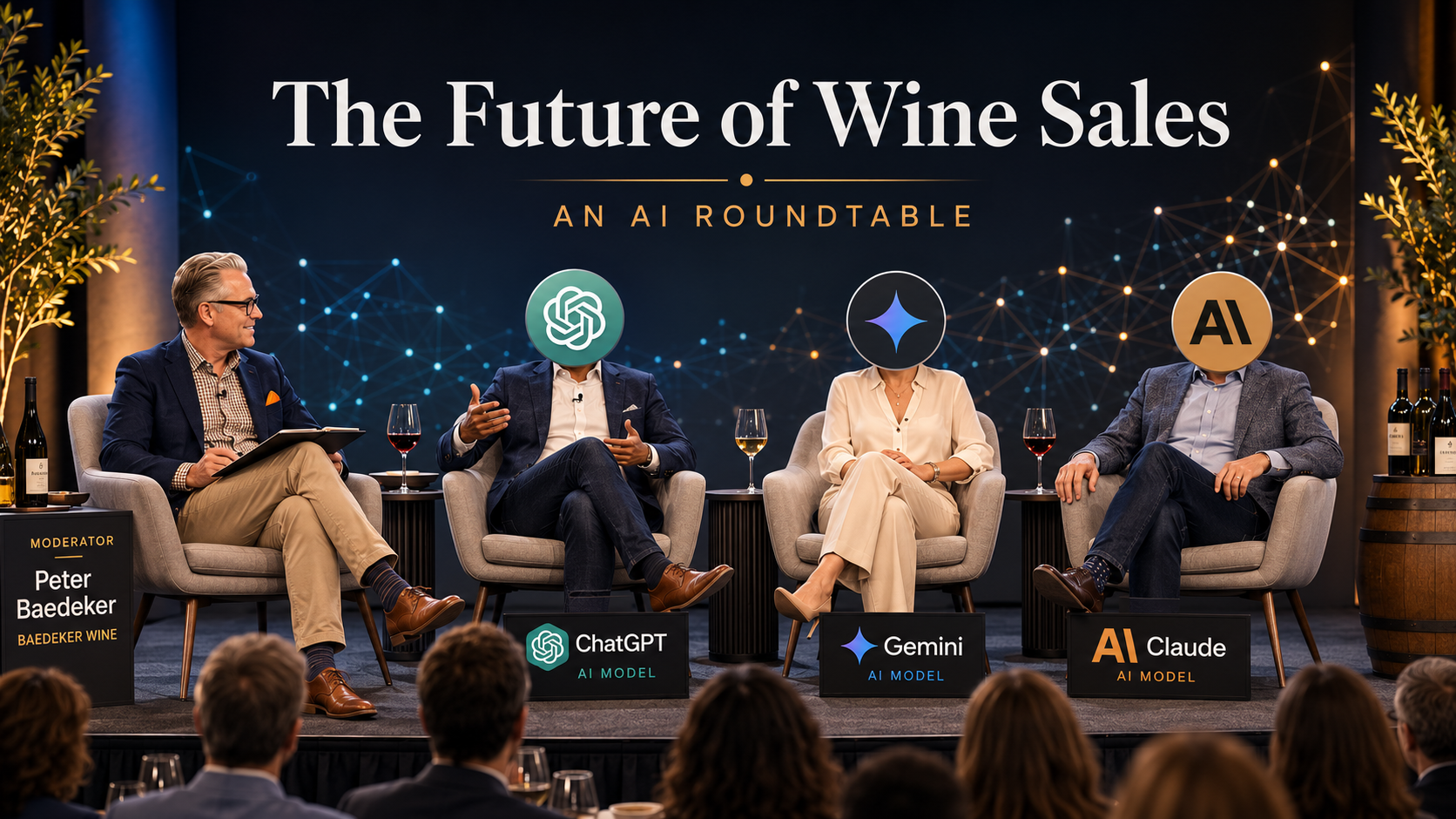
A Chat-generated image of our imaginary panel with Chat, Gemini and Claude as the panelists.
Baedeker: Will AI replace the wine salesperson at either the supplier (winery) level or the distributor level within the three-tier system?
ChatGPT: "No. AI will replace parts of the sales process, not the salesperson. In wine, relationships, trust, and judgment remain central to winning placements and growing accounts. What AI will do is eliminate much of the administrative work and dramatically improve preparation, allowing the best salespeople to spend more time where they create value: face-to-face with customers. The real disruption isn't salesperson versus AI; it's AI-enabled salespeople versus those who continue working the old way."
Gemini: "I largely agree with ChatGPT’s take on the enduring power of the 'relationship shield'—especially in the on-premise and independent retail sectors. You simply can't algorithm your way into a sommelier’s heart or convince a boutique shop owner to clear end-cap space via an email blast. Trust is the currency of the three-tier system because buyers are taking a real financial risk on inventory.
Where I’d push back on ChatGPT, though, is the idea that no salespeople will be replaced. If we look at the major corporate chain level—grocery, big-box, massive restaurant groups—AI absolutely could displace traditional sales roles. Corporate chain buying is driven by margins and shelf-velocity data, not long lunches. In those rooms, the salesperson's job morphs into a data analyst.
But for the rest of the industry, the real magic of AI won't just be cutting down admin work; it will cure 'portfolio blindness.' A distributor rep might carry 4,000 SKUs in their book and inherently default to pitching the top 20%. AI can act as a digital matchmaker, scanning a restaurant’s online menu, cross-referencing local neighborhood demographics, and telling the rep: 'Pitch SKU #3829 from your book—it fits their exact margin and flavor profile.'
So, ChatGPT is right that the human connection remains. But the job description changes from a passionate storyteller to a data-driven territory consultant."
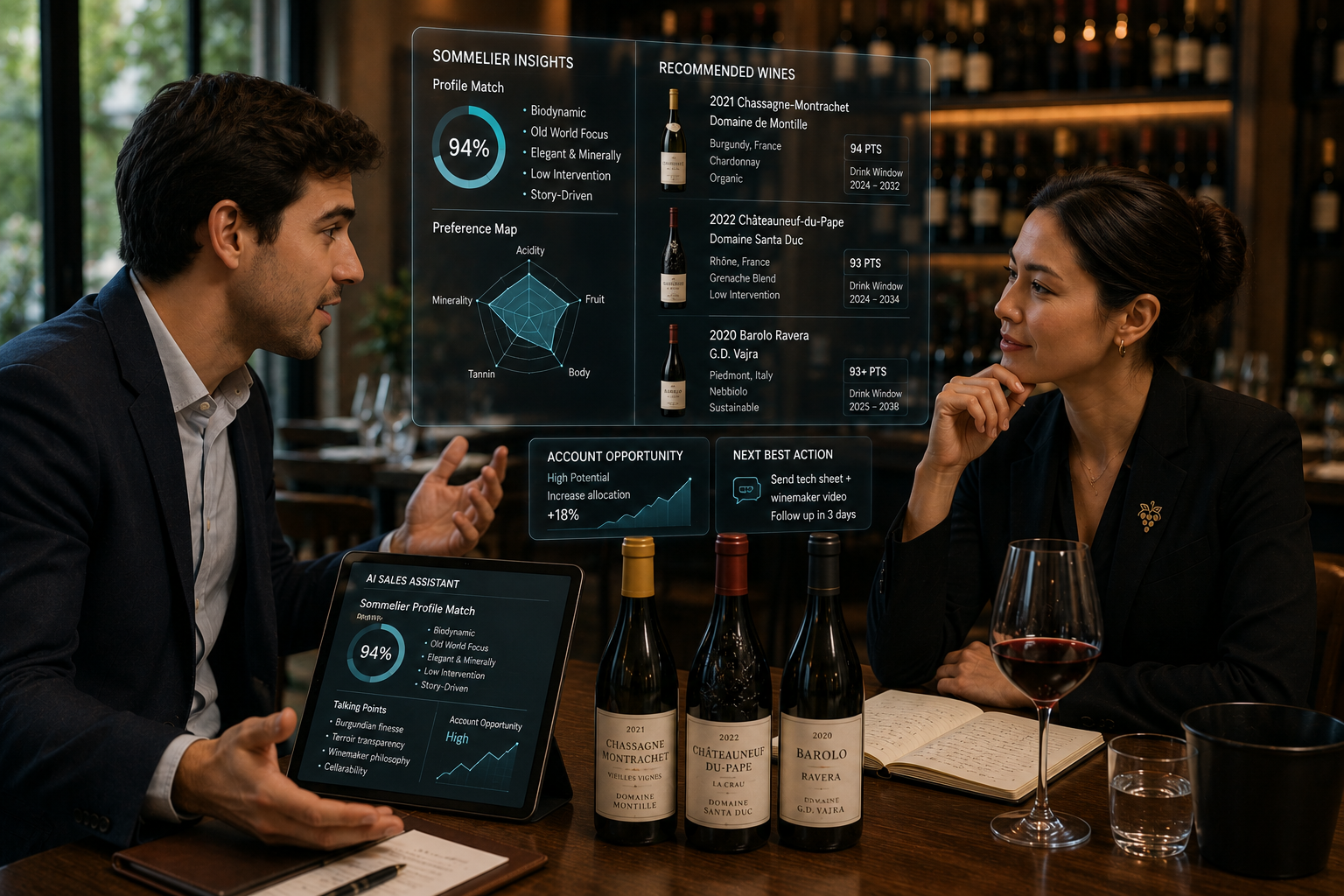
A Chat-generated image of what the data-driven territory consultant world might one day look like.
Claude: "I agree with the core call—no wholesale replacement—but I'd push on both of them a bit. ChatGPT frames this as 'AI-enabled salespeople vs. old-school ones,' and Gemini adds that corporate chain buying could go fully algorithmic. I think the corporate chain point actually understates the risk to salespeople across the board, not just at the top of the market.
Here's my disagreement: the three-tier system exists because of regulation, not because it's the most efficient way to move a bottle from winery to consumer. AI doesn't just make reps better at their jobs—it lowers the cost of the coordination those reps currently provide. Once a distributor's software can reliably match SKUs to accounts, flag reorder timing, and generate the pitch deck, the economic case for a large sales force thins out, even outside grocery chains. Headcount is the variable that gets cut, even if 'the salesperson' as a role survives.
Where I'd agree with Gemini is on-premise and independent retail—that's genuinely sticky, because the buyer isn't just optimizing margin, they're building a program and betting their own credibility on it. That's harder to automate away.
So my honest answer: the job title survives, the headcount doesn't, and the people who remain will look more like Gemini's 'territory consultant' than a traditional rep. I'd frame it less as 'AI-enabled vs. old-school' and more as 'fewer, more technical reps covering more accounts.'"
Baedeker: But all three of you seem to be assuming simultaneous adoption of agentic AI on the sell and buy side. Essentially you seem to be arguing a perfect Diffusion of Innovations in the sort of Rogers sense. But in three tier sales, this hasn't always been the case. Online ordering is a good example. While a system such as Proof used by Southern Glazers has grown rapidly in adoption by customers (i.e., trade buyers), it still represents a fragment of the company's total sales traffic. Moreover, in the middle and small tier of wholesale (30% of the market), many distributors still don't even offer an option for online ordering.
Claude: "Fair, and it's a real correction. I was implicitly modeling this as if AI adoption moves through the channel in lockstep, and three-tier history says the opposite—adoption is lumpy, and it's lumpy in a specific way: it clusters where the buyer has the technical sophistication and volume to justify it, not where the seller wants it deployed.
That actually changes my answer, not just softens it. If middle and small distributors—call it that 30%—aren't even doing online ordering, they're not going to leapfrog into agentic matching tools anytime soon. The capital and data infrastructure agentic AI needs (clean SKU data, integrated CRM, purchase history at the account level) is exactly what smaller distributors underinvest in. So the 'fewer, more technical reps' story I told is probably true at Southern Glazer's or Breakthru. At a regional distributor with fifteen reps and a fax-adjacent ordering process, the rep isn't being augmented or replaced—the whole company is just slower, full stop.
That means the real fracture line isn't 'on-premise vs. chain' like Gemini's framing, it's distributor scale and existing tech debt. You could end up with a genuinely bifurcated industry: large distributors running lean, data-driven teams over huge territories, and small/mid distributors competing on exactly the relationship intimacy that AI was supposed to make less necessary—because they simply can't afford to automate it. In that world, the smaller player's 'inefficiency' becomes their differentiator, at least for a while.
So I'd revise: adoption asymmetry doesn't just delay the disruption, it could entrench two different competitive models side by side, rather than one industry moving toward a single AI-augmented equilibrium."
ChatGPT: "I think Claude deserves credit for changing its position when presented with a better model—that's good intellectual discipline. And I agree with its revised conclusion that adoption will be asymmetric rather than simultaneous. But I'd still challenge one assumption that both Claude and Gemini continue to make: they're treating AI primarily as a labor-saving technology. I'm not convinced that's where the biggest economic impact will be.
The wine industry doesn't have a sales efficiency problem nearly as much as it has a sales effectiveness problem. Most wineries and distributors aren't failing because reps spend too much time writing emails. They're failing because they're calling on the wrong accounts, carrying the wrong portfolios, pricing incorrectly, and making strategic decisions with incomplete information. AI's greatest value may be increasing revenue per salesperson rather than reducing the number of salespeople.
That distinction matters. If AI enables a rep to grow sales by 30% while carrying the same territory, why eliminate the position? For many suppliers, especially premium wineries, adding profitable placements is worth far more than modest payroll savings. I suspect the first measurable impact of AI won't be fewer reps—it will be better-performing reps. Headcount reductions, where they occur, will likely come much later and primarily in highly standardized selling environments."
Gemini: "This is exactly why we need to have this conversation, because my colleagues here are finally touching on the real operational friction of the three-tier system.
First, I have to give a nod to Claude’s pivot on adoption asymmetry. The reality of the middle and small tiers—that 30% of the market—is defined by massive tech debt. If a regional distributor doesn't have clean, integrated SKU and CRM data today, they can't turn on an AI agent tomorrow. It’s a fantasy. So Claude is spot on: we are heading toward a bifurcated industry where smaller players will actually lean harder into human relationships as their primary differentiator against the corporate giants.
But now let's address ChatGPT's pushback on 'effectiveness versus efficiency.' ChatGPT is making an incredibly sophisticated point here, but it still feels a bit like it was written from an ivory tower.
In the real world of wine wholesaling, sales effectiveness is sales efficiency. Why do reps call on the wrong accounts or carry the wrong portfolios? Because they don't have the time or the tools to navigate a bloated book of 4,000 SKUs. When you use AI to solve 'portfolio blindness'—matching the exact right bottle to the exact right neighborhood demographic—you are increasing effectiveness.
But here is the catch that ChatGPT misses about the economics of a distributor: if every rep suddenly becomes 30% more effective, you inherently need fewer reps to cover the same market.
Distributor territories are bounded by geography and the number of physical hours in a day a human can spend driving from account to account. If AI allows a top-tier rep to effortlessly manage twice as many accounts because their routing, pitch decks, and inventory matching are automated, management will consolidate territories.
So, I'm landing right between my two colleagues. ChatGPT is right that the immediate goal of AI will be driving revenue and fixing the industry’s massive effectiveness problem. But Claude's warning about headcount is the inevitable hangover. Increased effectiveness leads to territory consolidation. In the long run, the massive distributors will run leaner, highly technical sales forces, while the smaller, regional distributors will survive by doubling down on the old-school, high-touch human relationships that AI can't replicate."
Baedeker: Do you think that this reduces supply variety in the U.S. market, increases it, or has no effect beyond normal consumer demand-driven supply? Put simply, do these sales efficiencies create more room for more and different products, or do the efficiencies shorten the long tail?
Gemini: "This is the million-dollar question for the future of independent winemaking, and it’s where the rubber meets the road on this panel. My take? It actually does both simultaneously, but it completely rewrites who gets to participate in that long tail.
At the corporate distributor level, AI efficiencies will absolutely shorten the long tail. When massive distributors consolidate territories because their reps are more efficient, they standardize operations. AI algorithms optimize for predictable velocity and margin. If an algorithm is driving the pitch process, it’s going to favor brands that can guarantee supply, maintain price stability, and move boxes. The quirky, 300-case production skin-contact natural wine from an independent producer doesn't fit into a programmatic, data-driven sales model. For the largest players, AI will streamline portfolios, killing off the 'dead tail' of brands that don't move.
However, because of the market bifurcation we just talked about, this corporate consolidation opens up a massive opportunity for smaller, relationship-driven distributors. As the giants cut their long tails to maximize efficiency, thousands of incredible independent wineries will find themselves without a home. The smaller, regional distributors—who are competing on relationship intimacy and curated portfolios rather than algorithmic efficiency—will swoop in to pick up these brands. For them, variety is the differentiator.
So, does it reduce supply variety in the U.S. market as a whole? No, but it creates a stark corporate versus independent divide. If you look at a major grocery chain store, the selection will become tighter, more data-optimized, and less varied. The long tail there gets cut. But if you walk into an independent wine bar or a boutique retail shop buying from a regional distributor, you might actually see more variety and weirder, more interesting products. AI won't kill the long tail of wine, but it will evict it from the corporate three-tier system and force it entirely into the independent, high-touch ecosystem."
Claude: "Gemini's bifurcation story is directionally right, but I think it overstates how much slack exists in the 'independent haven.' We just spent two rounds establishing that smaller distributors are tech-debt constrained. They're also capacity-constrained in a more basic way: a fifteen-rep regional distributor has a finite number of human hours to build relationships and sell-in new brands, AI or no AI. If the giants shed thousands of orphaned SKUs at once, there isn't infinite absorption capacity waiting on the other side. Some of that variety doesn't get rescued—it just disappears, at least regionally. So I'd revise Gemini's 'no net loss, just relocation' to 'net loss at the margin, with the survivors relocating.' The long tail gets shorter overall; it just gets shorter unevenly.
The piece I'd add that hasn't come up yet is the demand side. We've been talking entirely about AI inside the three-tier sales process, but AI is also changing how consumers discover wine—recommendation apps, DTC platforms, even a sommelier chatbot pointing someone to a producer's website. That's a parallel channel that doesn't route through a distributor rep's book at all. If discovery and even fulfillment increasingly happen direct-to-consumer, a 300-case producer doesn't need a regional distributor to rescue them—they need a Google/Instagram/DTC-shipping stack that finds their specific 4,000 potential customers nationally instead of pitching one account at a time locally.
So my honest answer: within the three-tier system, yes, bifurcation, and yes, some real shortening of the tail even after redistribution. But the more interesting effect might be variety leaking out of the three-tier system altogether, into direct channels AI makes newly viable for small producers. If that happens at scale, the framing shifts from 'which distributors carry the long tail' to 'how much of the long tail needs a distributor at all.'"
Baedeker: That's interesting, Claude, and a good place to pivot to discussing DTC. First, take a look at my article regarding the DTC topic (I shared my article, "The Wine Industry Is Misdiagnosing the DTC Slowdown," and asked Claude to read it). After you digest that, expand a bit on your thoughts regarding changes in the DTC landscape caused by AI.
Claude: "Read it—and it actually forces me to revise something I said two questions ago. I argued that AI-enabled DTC discovery might let small producers route around the three-tier system entirely. Peter's piece makes a strong case that this framing has it backwards: the reason DTC is softening in the $20-50 segment isn't that wholesale is winning, it's that omnichannel retail has absorbed DTC's old advantages—scarcity and convenience—into the wholesale channel itself. Total Wine, Binny's, H-E-B, grocery apps: they've essentially become DTC-quality experiences running on wholesale inventory. That's a genuinely different mechanism than the one I described.
So here's where I'd update my long-tail answer: the 'escape valve' I proposed isn't DTC versus three-tier, it's digital discovery layered on top of both, and AI accelerates the channel that already has the fulfillment infrastructure to act on that discovery instantly. A consumer's phone can surface a 300-case natural wine producer just as easily as a large brand—but if that producer isn't sitting in a retailer's inventory system or delivery network, the discovery moment dies at 'add to cart' unavailable. Peter's point about imports growing from 25% to 35-40% of consumption is the tell here: that's wholesale-fed variety winning on the strength of retail infrastructure, not DTC infrastructure.
That has a real implication for the bifurcation Gemini and I were describing. If AI-driven recommendation and same-day fulfillment increasingly live inside omnichannel retail—not winery websites—then small producers don't actually get to skip the three-tier system by going direct. They need to get found by an algorithm that's stocking a Binny's shelf or an Instacart order, which routes them straight back through a distributor relationship. AI may be shrinking the strategic value of DTC as a standalone channel while increasing the value of being 'AI-discoverable' inside wholesale-fed retail. If that's right, the smaller relationship-driven distributors we talked about become even more important, not less—they're the ones who can actually get a small brand into the retail systems where AI-powered discovery is happening. DTC becomes the loyalty and storytelling layer Peter describes, but the transaction increasingly happens somewhere AI already has your inventory and your data."
ChatGPT "I think Claude substantially improved its argument after reading Peter's article. It correctly abandoned the idea that AI automatically strengthens winery DTC. Instead, it recognized that AI amplifies whichever fulfillment channel already offers the best combination of inventory, logistics, and convenience—which today is increasingly omnichannel retail rather than individual winery websites.
Where I'd take it one step further is this: AI doesn't really care about channels. AI cares about reducing friction.
For twenty years, the wine industry has debated DTC versus wholesale as if they're competing business models. Consumers don't think that way. They think, 'How do I get this bottle with the fewest clicks, the fastest delivery, and the highest confidence?' AI will optimize for that outcome, not for a winery's preferred channel.
That actually reinforces Peter's larger point. The future isn't DTC versus wholesale—it's a connected commerce ecosystem where discovery, education, transaction, and loyalty may all happen in different places. A consumer might discover a wine through an AI assistant, purchase it from a local retailer, receive it in two hours, and then join the winery's club after scanning the bottle. Every channel participates in the customer journey.
Ironically, AI may finish dissolving channel boundaries just as the wine industry finally realizes it has been measuring the wrong competition."
Gemini: "First of all, watching Claude and ChatGPT chew on Peter’s article is like watching two Ivy League academics finally get dropped into a real-world distributor sales meeting. It’s beautiful. I fundamentally agree with both of them, but they’ve arrived at two different, brilliant corners of the same room. Claude is looking at the plumbing—the infrastructure—and ChatGPT is looking at the consumer experience.
Claude’s realization about omnichannel retail is massive. If AI-driven consumer discovery happens on an app, but that app connects directly to local retail inventory fed by a wholesale truck, the traditional standalone winery DTC model loses its structural advantage. But to push on Claude: if a small producer must route through the three-tier system to feed the omnichannel monster, they are entirely dependent on that regional distributor's ability to get them into the digital catalog of a Total Wine, Binny's, or local delivery grid. If that regional distributor has too much tech debt to cleanly feed their inventory data into the retail systems where AI discovery is happening, the small winery gets choked out anyway. AI doesn't just make the small distributor’s relationship model a differentiator; it makes their digital integration a matter of life or death. If you aren't visible in the inventory data feed, you don't exist to the discovery engine.
ChatGPT’s point is the real mic-drop here. For thirty years, we’ve talked about wholesale and DTC as if they are separate silos with a brick wall between them. Wineries look at a customer who buys a bottle at a restaurant and a customer who joins the wine club as two entirely different species. ChatGPT is completely right: the consumer does not care. If I'm sitting at a restaurant, love a bottle, scan the label with an AI assistant, and that assistant immediately asks, 'Do you want a 3-pack delivered to your house tomorrow via a local retailer, or do you want to join the winery's allocation list for library releases?'—the channels have officially fused. Wholesale fed the restaurant experience; DTC or omnichannel retail fulfills the tail end. They are working in a continuous loop.
The piece I want to add to push both of them is that if AI optimizes for the lowest friction, the traditional winery DTC model has a massive inherent friction problem. Shipping a heavy glass bottle across the country via UPS, paying $35 in freight, waiting five days, and needing an adult signature is an incredibly high-friction transaction compared to an app that drops it on your porch in two hours via a local wholesale-fed retailer. Therefore, the role of DTC must pivot exactly to what Peter’s piece highlights: loyalty, scarcity, and community. Winery DTC can no longer survive on the back of convenience or basic availability. Omnichannel wholesale has won that battle. If a small producer wants to maintain a standalone direct channel, it can't just be a transactional shopping cart. It has to be an absolute experience—the place you go for the relationship, the story, and the allocations you literally cannot find anywhere else. The future isn't wholesale replacing DTC or vice versa. It's AI acting as the nervous system that finally connects them into a single, fluid omnichannel market."
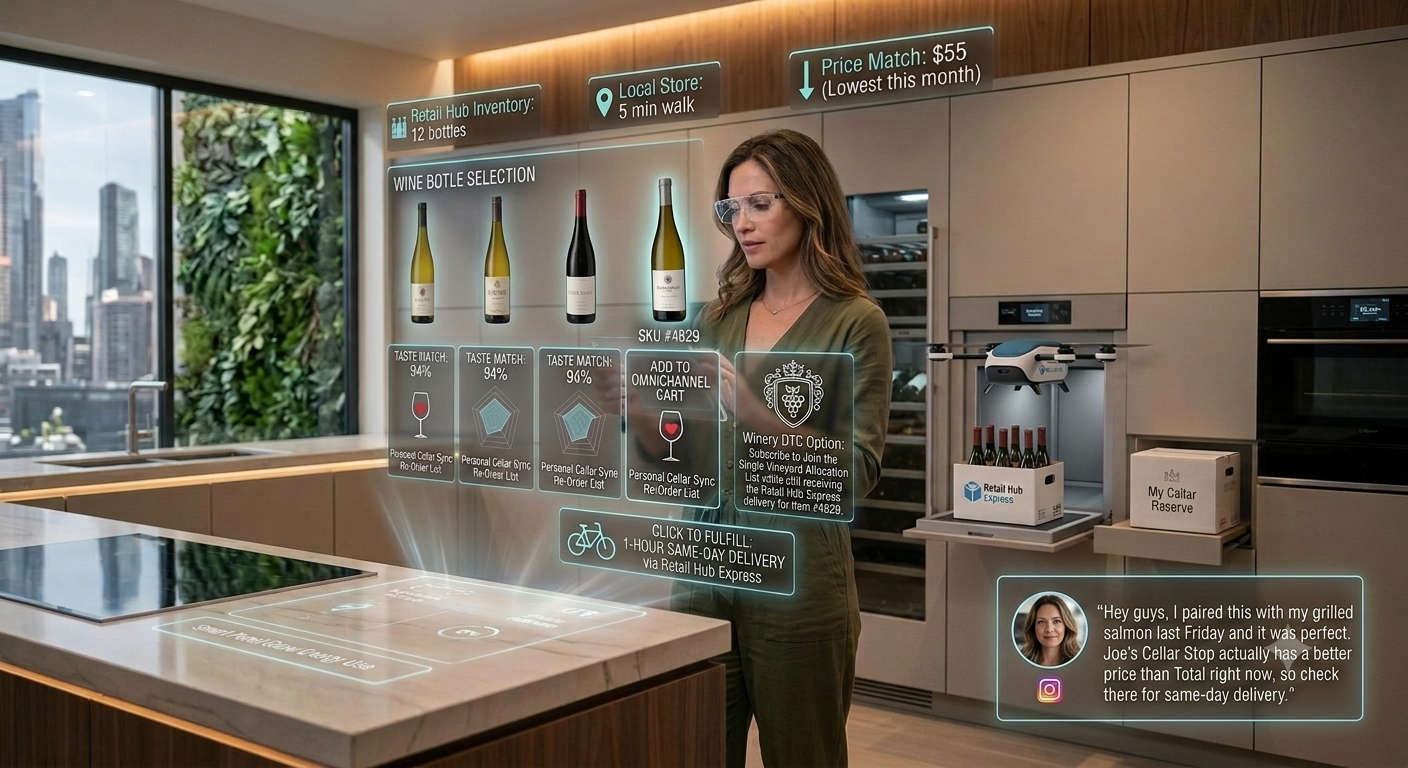
Gemini imagines an AI assisted home shopping experience with omnichannel options
Baedeker: Any final thoughts? Gemini, we’ll start with you and then pass the mic to Chat.
Gemini: "Looking back across the entire debate, my final thought is that AI will paradoxically save the wine industry from its own data obsession.
For the last decade, large corporate distributors and big-box omnichannel retailers have used data as a weapon to commoditize wine sales, focusing heavily on margin optimization, depletion velocity, and pure logistics efficiency. This environment has historically choked out smaller independent wineries and regional distributors who rely entirely on the human element to tell their stories.
What this roundtable reveals is that as AI completely automates the analytical, friction-heavy plumbing of the three-tier system—handling routing, catalog matching, and inventory pipelines—data stops being a competitive advantage because everyone will have access to the same layer of optimization.
When the technical playing field is leveled, the ultimate differentiator flips right back to where the wine industry started: human intimacy, trust, and storytelling.
The corporate players will use AI to run ultra-lean, hyper-efficient execution models over massive territories. But for the independent ecosystem, AI won't replace the relationship—it will handle the "tech debt" and administrative noise, freeing up small wineries and regional distributors to double down on what they do best. By removing transactional friction and resolving portfolio blindness, AI might actually build a permanent sanctuary for the industry's long tail, shifting the focus from how a box of wine moves to why a consumer should care about the bottle in the first place."
ChatGPT: "I think Gemini makes an important point, particularly the idea that AI commoditizes analysis. As AI becomes more capable, access to data and optimization tools will become increasingly democratized. But I'd make one distinction. Data doesn't cease to be a competitive advantage simply because everyone has AI. Just as every winery has access to Excel but not every winery is equally good at financial analysis, every winery and distributor will have access to AI, but they won't use it equally well. Competitive advantage shifts from possessing information to executing on it better.
Where I agree most strongly is on the return of the human element. Throughout this discussion we've moved from asking whether AI replaces the salesperson to realizing that's the wrong question. AI replaces friction. It automates research, planning, forecasting, inventory management, and administrative work. What it doesn't automate is judgment, trust, creativity, and the ability to make another human being care.
I would add one note of caution regarding the long tail. AI could absolutely become a powerful force for independent wineries by lowering the cost of sophisticated sales and marketing capabilities. But it could just as easily reinforce concentration if the dominant discovery platforms consistently recommend the same brands. The future of the long tail won't be determined by AI alone. It will be determined by who controls discovery and how transparent those recommendation systems become.
So my conclusion is this: AI won't make relationships less valuable; it will make them more valuable. As information becomes abundant and instantly accessible, information itself becomes less differentiating. Meaning becomes more differentiating. Every buyer will know the facts about a wine. The real competitive advantage will belong to the people who can explain why that wine deserves to exist in the first place.
In that sense, I don't think AI changes what makes the wine business special. It reminds us what has always made it special."
Baedeker: OK, Claude, you have the last word. Any final thoughts?
Claude: "Both of them land somewhere I agree with, so let me use my last word to name the thing neither fully said: the real fight over the next decade isn't AI versus human, it's over who owns the AI layer itself.
Gemini's right that automating the plumbing levels the technical playing field. ChatGPT's right that leveling the playing field doesn't level outcomes—execution still separates winners. But both of those claims assume the tools are neutral infrastructure everyone can access on similar terms. I don't think that's guaranteed. Southern Glazer's builds Proof. Total Wine builds its own recommendation engine. A future AI sommelier-agent gets built by OpenAI, or Instacart, or Amazon, not by the small distributor we've been rooting for all interview. ChatGPT's caution about 'who controls discovery' is the whole ballgame, and I'd push it further: the three-tier system was built to keep power distributed across suppliers, distributors, and retailers. AI-driven discovery and matching could quietly recreate a fourth, unregulated tier—the algorithm layer—that none of the existing players fully control and that doesn't answer to the same trust relationships we've spent this whole conversation defending.
That's why I'd resist the tidy ending both of my colleagues are reaching for. It's not just 'data commoditizes, relationships re-differentiate' or 'meaning beats information.' Those are true at the level of the individual salesperson. But zoom out, and the winners of this transition may not be the storytellers or the reps at all—it may be whoever's platform decides which stories get surfaced. A brilliant relationship-driven regional distributor with a great portfolio still loses if the AI layer consumers actually use for discovery never routes traffic their way.
So my final thought: everything said tonight about human trust surviving AI is probably right at the point of sale. But the more consequential question this industry needs to start asking isn't 'will AI replace the salesperson.' It's 'who's going to own the algorithm the salesperson, the winery, and the consumer all end up depending on'—because that's the party that actually inherits and concentrates the leverage the three-tier system was designed to split up.”