Headline: Your Brain Can’t Count (Don’t Worry: Mine Can’t Either)
Why we are biologically hardwired to misread the state of the alcohol industry.
Look at this image below, from left to right. Say the number on the dice in the first picture out loud, then the next picture, and then the number of apples in the last picture. Don't worry, it's not a trick, you'll get it right:
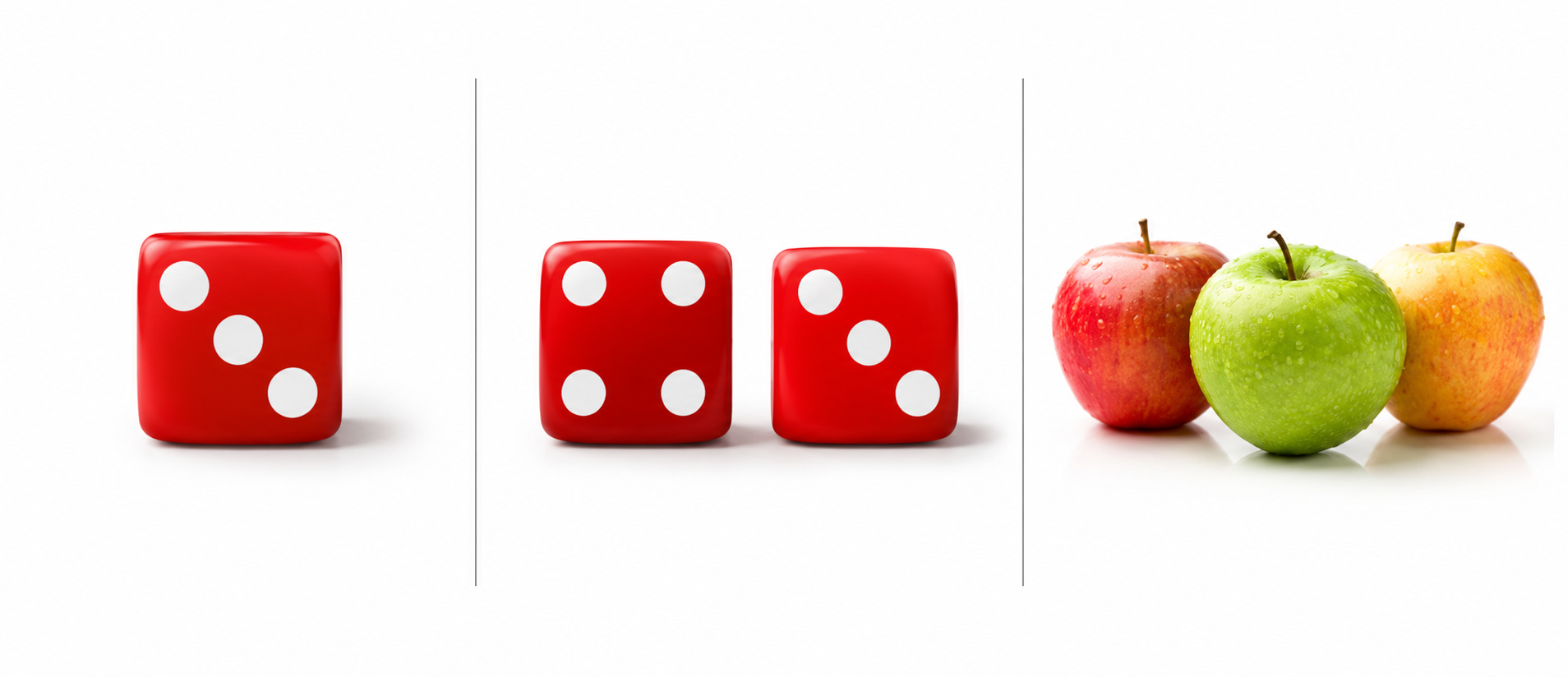
Look at the image from left to right and say out loud the number on the one die, the combined number on the two dice, and the number of apples in the bunch.
Did you notice that in all three examples, you did not actually count the dots on the dice or even the number of apples, but your brain immediately went to three, seven, and three? This is called subitizing, and it’s a cognitive shortcut that is critical to human functioning while at the same time illustrative of how confined we are cognitively. From the age of five months, the human brain possesses this innate, remarkably accurate and effortless ability to recognize the quantity of items in a small set without counting them individually. Unfortunately, the limitation on this capability is about 4 to 6 things, which is why two six-sided dice have been used in games for about 5,000 years. It’s also what leads to the next limitation in the human brain: scale blindness.
The moment a number scales past a shockingly tiny amount of things that our brain is hardwired to assimilate, we stop thinking linearly and start thinking logarithmically. That is, we place large numbers into abstract concepts, even emotions. 5,000 years is a number we cannot really think of, it’s just a “really long time ago.” To demonstrate this phenomenon, a group of scientists at the University of Richmond in Virginia in 2013 conducted an experiment where they gave participants a piece of paper with a blank horizontal line drawn on it. The far-left point of the line was labeled 1 thousand, and the far-right point was labeled 1 billion. The task was to place a hatch mark on where one million belonged on that line. A shocking roughly half of the participants placed the mark in the middle of the line. If the participants had been mapping out the problem mathematically, the hatch-mark would belong about 0.01 inches from the left starting point on a ten-inch line. 50% of participants placed it about 5.0 inches, or halfway. 1 million is 1/1,000th of 1 billion. But the human brain uses the 3-word grouping of "one thousand->one million->one billion" as its map rather than a linear approach. Turns out, most of us are like Lloyd in Dumb & Dumber, which is why the dialogue is so funny when he asks Mary to level with him on his chances of being with her. She replies, “not good,” to which Lloyd asks, “You mean not good like one out of a hundred?” to which Mary replies, “I’d say, more like one out of a million.” We all know the next line, and as deflating as it might sound, we’re all about as dumb as Lloyd when it comes to scale blindness.
Quick number grouping rather than counting allows a person to swiftly identify the difference between 1 lion and 4 lions or quickly grab the two stacks of 4 apples and 3 apples instead of the smaller stacks. Scale blindness keeps us from that old business term “paralysis by analysis.” Counting the blades of grass in the savannah and measuring the distance to a perceived threat means you’re probably going to get eaten by a lion in the process. Unfortunately, in a modern world, it causes us to use faulty math in response to headlines and even reports with data in them, see things out of proportion, and jump to narrative conclusions like Lloyd’s.
So, what does all of this have to do with the alcohol industry?
It relates to something I’ve been vocal about for years, and which the data keeps confirming: the narrative that the sky is falling in the alcohol business is mostly driven by these human limitations and emotions.
Let’s use a recent example of some common headlines and then drill into reality, forcing our linear brain to do some work. Recently, the Financial Times headline “Drinks makers left with lake of unsold spirits as demand drops,” made quite a splash and continued the narrative of a dying alcohol industry. The video that made its way around social media featured a GenZ-aged reporter, using her journalistic skills to grab attention. Both the printed story and the video lead with the number $22 billion—the amount of unsold spirits inventory reported by five of the biggest public spirit companies: Diageo, Brown-Forman, Campari, Remy, and Pernod. This was followed by isolated charts of growing inventories at each company since 2011.
Presented this way, our brains say, “Holy s---t! $22 billion of unsold inventory! Clearly EVERYONE has stopped drinking!” We then group that information with one to three other headlines we’ve read about changing alcohol consumption, and we’ve made our conclusion: the alcohol industry is on the brink of extinction.
Before declaring the end of the alcohol industry, it’s worth asking a simple question, though: $22 billion compared to what? Where is the denominator?
The denominator is somewhere around $1.5 Trillion. That’s the IWSR and Intel Market Research number for the global alcohol market for 2026.
Yes, spirit inventories are at very high ratios right now for sales, which is really all that matters. That means more COVID-era influenced inventories will be turned into cash to address heavy debt burdens, and some inventories will be aged and released in a future spirit consumption boom cycle, which will inevitably come. It does not mean everyone has stopped drinking. To give her credit, the Financial Times journalist did end her social media video by stating that what this means for the reader is probably a better price on your margarita within the near future. But she started with the $22 BN number and “lake of booze” language because, well, she’s a good journalist.
The headlines around that narrative also demonstrate this peculiar way we humans think and behave. Let’s consider for example how the $22 Billion number and “lake of inventory” image feeds the false narrative created when we subitize the 3-pronged idea that 1) young people don’t drink, 2) everyone is drinking less, and 3) we’ve entered an age of enlightenment where we’re all either like Tom Cruise treating our bodies like temples, or using Ozempic to permanently curb our appetite for food and drink.
Despite the bull-whip phenomenon of sales and inventory created by the crazily aberrant COVID period, we tend to ignore the normalization that occurs in the data over very long periods of time, because we can’t conceptualize very long periods of time. As I said in the headline, I can’t either. Though I sort of get what the physicists are saying when they talk about the universe being 13.8 billion years old, for example, I honestly can’t totally get my head around that.
When our brains see headlines such as “The U.S. alcohol market lost nearly 360 million 9L cases from the end of COVID to 2025,” again, we freak out and make big leaps to assuming universal behavior. And again, we forget to look at the denominator. That number is just over 3 billion cases per year of alcohol sold in the U.S. (converting everything to 9L cases). Using our paper line experiment, if you drew zero on the left side of the line (literally no alcohol market) and 3 billion on the right side and asked your friends to place a mark at 360 million, most of them would put it somewhere around the middle when it belongs at about one inch from the left on the ten inch line. That’s right, this annual U.S. alcohol market where apparently nobody drinks anymore occupies 9 inches of that ten-inch line. Compare that 360 million case cumulative drop to the total volume over the same five year period and it would be hard to even draw the line on the left side.
Finally, we see these subitizing and scale blindness errors, I believe, most prominently in the narratives that build around the change in consumption. These changes are real—RTDs are hot right now, drinking nicer wine less often is happening within core demographics, etc. But long-term total ethanol consumption patterns show that things don’t really move much over the long run. Packages change, varietals come in and out of fashion, premiumization happens and reverses, etc. Reuters published a nice story about this last December (“Are Americans drinking less? New data says yes, but not by much.”), but if your brain is already operating on fear that the end is near, you probably didn’t pay much attention to that article.
Globally, total ethanol consumption seems to hover around 5-6 liters per legal drinking age adult per year. IWSR predicts global alcohol consumption in 2035 will be about 1% less than 2025 levels. Not an exciting growth story, but certainly not the fallacy of extinction. If that’s right (and don’t get me started on prediction making), then the global alcohol market will still be right around 28 billion 9L cases a decade from now. If I have the dream of creating a 28,000-case wine brand, then I will need one millionth (1/1,000,000) of the share of the available market.
So…yes Lloyd…
I’m saying there’s a chance.